


 Česká republika
 EU
EU Andorra
 Angola
 Argentina
 Australia
 Bosnia and Herzegovina
 Brazil
 Canada
 Chile - requires VAT ID or passport nr
 Hong Kong
 Iceland
 Israel
 Japan
Japan Korea, Republic of (South Korea)
 Kyrgyzstan
 Macedonia
 Mexico
 Montenegro
 New Zealand
 Norway
 Pakistan
 Peru
Peru Philippines
 San Marino
 Saudi Arabia
 Serbia
 Singapore
 South Africa
 Switzerland
![Taiwan, Province of China[a]](https://files.upgates.com/graphics/countries/tw.svg "Taiwan, Province of China[a]") Taiwan, Province of China[a]
Taiwan, Province of China[a] United Arab Emirates
 United States (continental)
 Uruguay


A Physiotherapist's Perspective: What is Barefoot ?
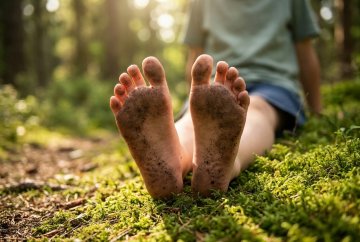
Barefoot. Bare — naked, empty. Foot — well, foot. Walking without shoes.
Oh great, another trend. But if we think about the evolution of our species for a moment — newborns don't arrive wearing socks. There are no booties in the womb, let alone those adorable little trainers for budding young athletes. Babies don't have hooves to protect their delicate feet either. And yet the urge to get something on those sensitive little feet as soon as possible — so they don't catch a cold or get hurt — is overwhelming. I recently spotted sexy leopard-print plush heels for infants. Yes, really.
These days, going barefoot is fashionable. One could even say, without exaggeration, that a full-blown mania has taken hold — in both a positive and a not-so-positive sense. Ordinary people and experts alike — whether in shoe manufacturing or healthcare — have split into two irreconcilable camps. On one side: the barefoot devotees. On the other: the defenders of conventional footwear. And somewhere in between, stumbling along in confusion, are those who sometimes wear regular shoes and sometimes just head out barefoot.
Let's try to calm things down a little and look at the human body from the ground up — literally, from the bottom. The foot is a complex piece of machinery. It's made up of many bones connected by joints and ligaments, with both short and long muscles contributing to its movement — all linked through fascial chains to the rest of the body. (A detailed anatomy lesson will have to wait for another time and place.)
In essence, the foot works like a cat's whiskers or an insect's antennae — its job is to map the terrain and send information to the brain via countless nerve endings. Messages like:
"Watch out, you're walking on hard ground — please stop stomping, or you'll end up with an artificial joint. Or several."
Or: "You're walking on moss — do you even realise how wonderful that is? See, if you didn't stomp so much, how good you'd feel."
Or simply: "Hole!" — and that's worth pausing on. A well-trained foot sends the signal about stepping into a pothole to the brain so quickly that all the relevant parts of the body react in an instant, preventing the ankle from twisting.
It's fascinating to watch small children. Take a close look at their bare feet sometime. Their little toes really do behave like antennae, constantly feeding the brain with information. On one hand, this forces the brain to rapidly adapt muscle activity; on the other, it teaches the child and builds movement experience layer by layer. A small child's feet are in constant motion on their own, and we nosy physiotherapists can tell from them how well a child is developing and what lies ahead once they finally stand up on those little legs.
An older child's or adult's foot, however, has already picked up its bad habits. And if it doesn't get enough opportunity to practise reading surfaces while walking, that ability gradually falls asleep — or even atrophies. Such a person tends to stomp, develop fallen arches, experience joint or back pain, and show various lower limb misalignments in the shape of X or O.
Which brings us to today's point. Barefoot training trains our feet. And in doing so, it trains our brains too.
As both a regular person and a physio, there's another key feature of barefoot footwear that matters to me: respect for the natural shape of the foot. These shoes — or rather, non-shoes — are wide enough at the front that they don't squeeze the toes together, allowing them full freedom of movement. This is a crucial feature. Almost every day someone tells me they absolutely don't wear narrow, pointed shoes. In 100% of cases, all I need to do is hold their own shoe up against the sole of their foot from below. The look of surprise when they see their big toe and little toe both extending beyond the edge of the sole is always telling. And it's precisely this continuous pressure — which our feet are subjected to for much of the day — that triggers that familiar feeling of a stiff back, aching glutes, thighs, calves, and soles. In many women, it can even be linked to headaches.
So why should you believe any of this?
Let me share my own experience — now more than a decade long. I always wore fairly flat shoes, except for a brief platform phase that earned me the nickname "Little Stomper" from my friends. Flat, but narrow. Every day I looked forward to the moment I got home and could finally take them off. Then one day I had the slightly mad idea of just leaving the shoes at home. It worked — and for three days I walked barefoot everywhere. The feeling was priceless. Not only did the back pain that had been my daily companion disappear, but I also earned the reputation of either an antisocial eccentric or someone who simply couldn't afford shoes. So I bought my first pair of barefoot shoes — partly because the people around me found it deeply unhygienic that I was walking barefoot in places where they wore shoes, like shops or pubs. Funny — it never occurred to me that their shoes walking where I was barefoot might be the unhygienic part.
Why should you believe me? I'm tempted to write: Because I'm a physiotherapist and we're always right! But I won't. You can believe me because I'm genuinely fascinated by the human body, and I continuously accumulate both theoretical and practical knowledge. I experiment on myself. And I only pass information on once I'm confident it actually works.
Article written for peerko® by experienced physiotherapist Mgr. Martina Miklovičová